Last updated
How Many Restrooms Does a Concert Need?
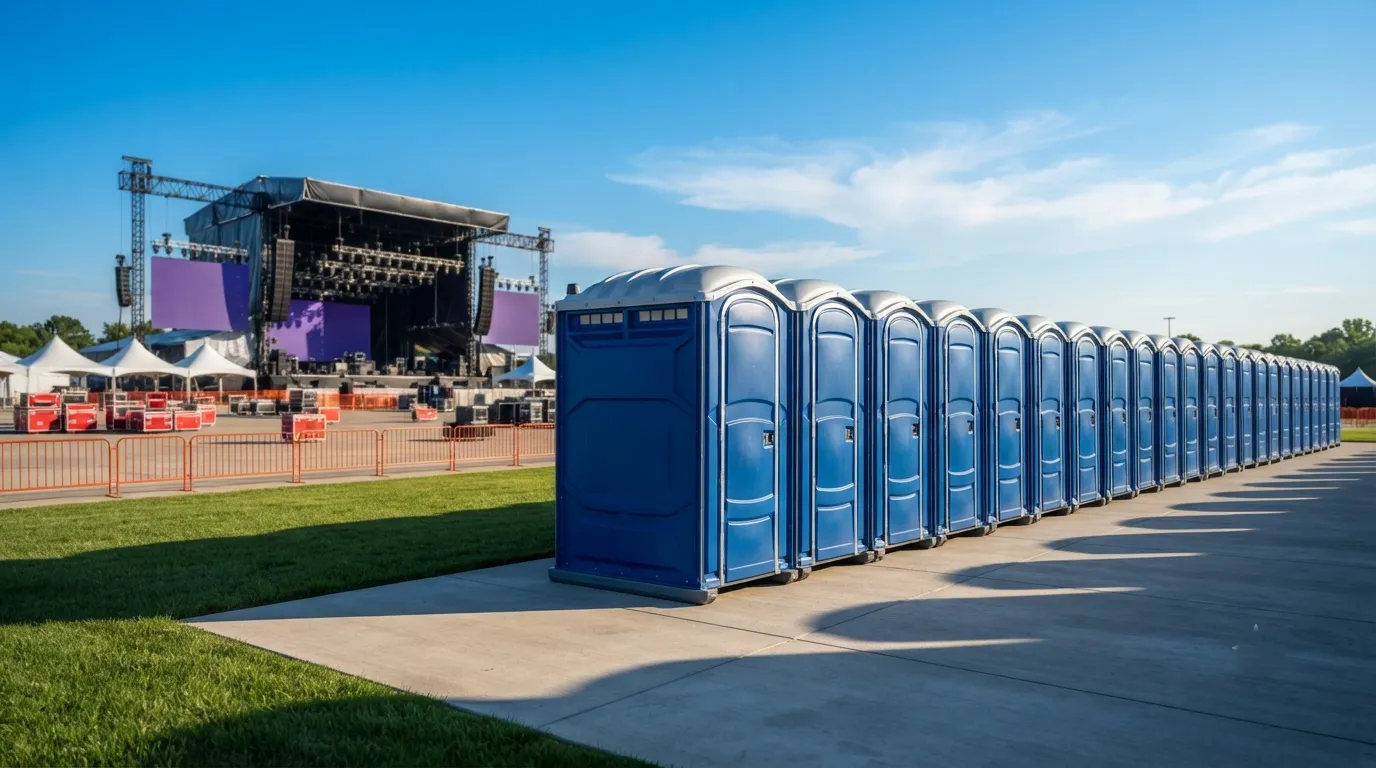
Start with the OSHA table, then adjust for real crowd behavior. 1926.51(c) sets 1 toilet for 20 workers or fewer, then 1 seat and 1 urinal per 40 up to 200, but concert audiences move differently than a jobsite crew and drink more. Most promoters in Weston plan closer to 1 unit per 50 attendees for a few hours of standing-room music, tighter if beer sales run the whole show. A crowd of 500 gets you into double digits fast, and that is before you set aside ADA accessible units per ADA Standards 213.2, which requires at least 5 percent of a cluster to be accessible, never fewer than one. Add a deluxe flushable option near VIP or backstage if the show has a sponsor tent, and check the placement guide before you lock the site map, because sightlines and generator cords matter as much as headcount. If you are unsure where to start, run the numbers through how many porta potties do I need before you call. We also stage extra handwashing stations near food vendors, since 29 CFR 1910.141(d)(2) requires soap and towels or a hand dryer, not sanitizer alone, anywhere staff or vendors are handling food. For multi-day festivals we swap some standard units for restroom trailers, which hold up better under continuous heavy use than stand-alone units, and a 4-stall unit clears lines faster during set breaks. Southwest Ranches shows, about 7.3 miles southeast of Weston, follow the same math, just with a shorter drive for our trucks.
What Does a Concert Restroom Package Cost?
Concert pricing depends on unit mix, duration and how many stalls you need moving at once. A single-day standard unit rents in the 100 to 350 dollar range, while multi-day festival pricing for standard units runs 200 to 800 dollars depending on service frequency and cleaning schedule. Restroom trailers built for a one-day event run 2,499 to 3,899 dollars, which covers stalls, sinks, and often air conditioning for a headline show. Weekend festivals pull from the weekend bands instead: standard units run 125 to 400 dollars, and trailers run 900 to 3,000 dollars for the weekend.
| unit | day | event | weekend |
|---|---|---|---|
| standard unit | 100-350 | 200-800 | 125-400 |
| ADA unit | 200-400 | - | 199-300 |
| restroom trailer | 175-2,500 | 2,499-3,899 | 900-3,000 |
Delivery adds 100 to 500 dollars depending on load size and site access, and a service fee for weekend turnaround runs 400 to 1,200 dollars on bigger festival footprints. Check porta potty rental cost or porta potty rental per day for baseline pricing outside festival scale, and restroom trailer rental cost if the show calls for a trailer fleet. Multi-weekend residencies sometimes make more sense on a monthly porta potty rental instead of booking each date separately.
Where Can Units Be Placed on a Concert Site?
Placement follows the same access rules as any jobsite delivery: a roll-off dumpster rental or restroom trailer both need roughly 60 feet of straight clearance behind the truck to set down safely, so load-in routes for stage gear and restroom trucks often share the same lane. ADA units need a clear route at least 36 inches wide per ADA Standards 403.5.1, and the unit door opening itself needs a minimum 32 inches per ADA Standards 404.2.3, so gravel lots and grass fields both need a flat, stable surface under ADA Standards 302.1. We stage temporary fencing around restroom clusters to manage queue lines and keep foot traffic off cables, and pair it with crowd control barriers where the venue expects a rush between sets. Weston shows without permanent power sometimes need a light tower near the restroom bank for night visibility, and a temporary power pole if food vendors are drawing from the same circuit. Backstage catering areas that use paints or cleaning chemicals near staging structures fall under OSHA 1926.51(f)(1) for washing facilities, which applies specifically to paints, coatings, herbicides or insecticides work, not general handwashing. For grounds with catering tents running heavy grease, a grease trap pumping visit before and after the show keeps drains clear. Cooper City venues, 12.2 miles southeast of Weston, and North Lauderdale sites, 19.6 miles northeast, get the same site walk before we finalize a layout.
How far in advance should I book concert restrooms?
Book as soon as the date and headcount are set, ideally 4 to 6 weeks out for a single-day show. Festival-scale bookings with trailers need more lead time since trailer inventory is limited. Weston Porta Pros can move faster for smaller shows, but trailers and ADA units go first.
Do concerts need ADA accessible restrooms?
Yes. ADA Standards 213.2 requires at least 5 percent of a clustered restroom bank to be accessible, and never fewer than one unit regardless of total count. See ADA restroom requirements for the full standard, including turning space and reach range rules.
How often are units serviced during a multi-day festival?
Service frequency scales with attendance, not just days. ANSI/PSAI Z4.3 sets one weekly visit as the baseline for light use, but festival crowds need same-day or twice-daily service. See how often are porta potties cleaned for typical festival intervals.
Can I add handwashing stations near food vendors?
Yes, and you should. 29 CFR 1910.141(d)(2) requires soap and towels or a hand-drying device at washing stations, not sanitizer alone, wherever food is served. Check handwashing station requirements for placement near vendor rows.
What happens if attendance is higher than expected?
Weston Porta Pros can add units on short notice if trucks are available, but emergency add-ons cost more than planned units. Overbuilding the count by 10 to 15 percent up front, especially ADA units, avoids the scramble. See emergency porta potty rental for rush options.
Next step
Get a delivery date
Tell us the address, the dates and the headcount. We size the order and confirm the route.